
3 Signals from SXSW EDU 2026
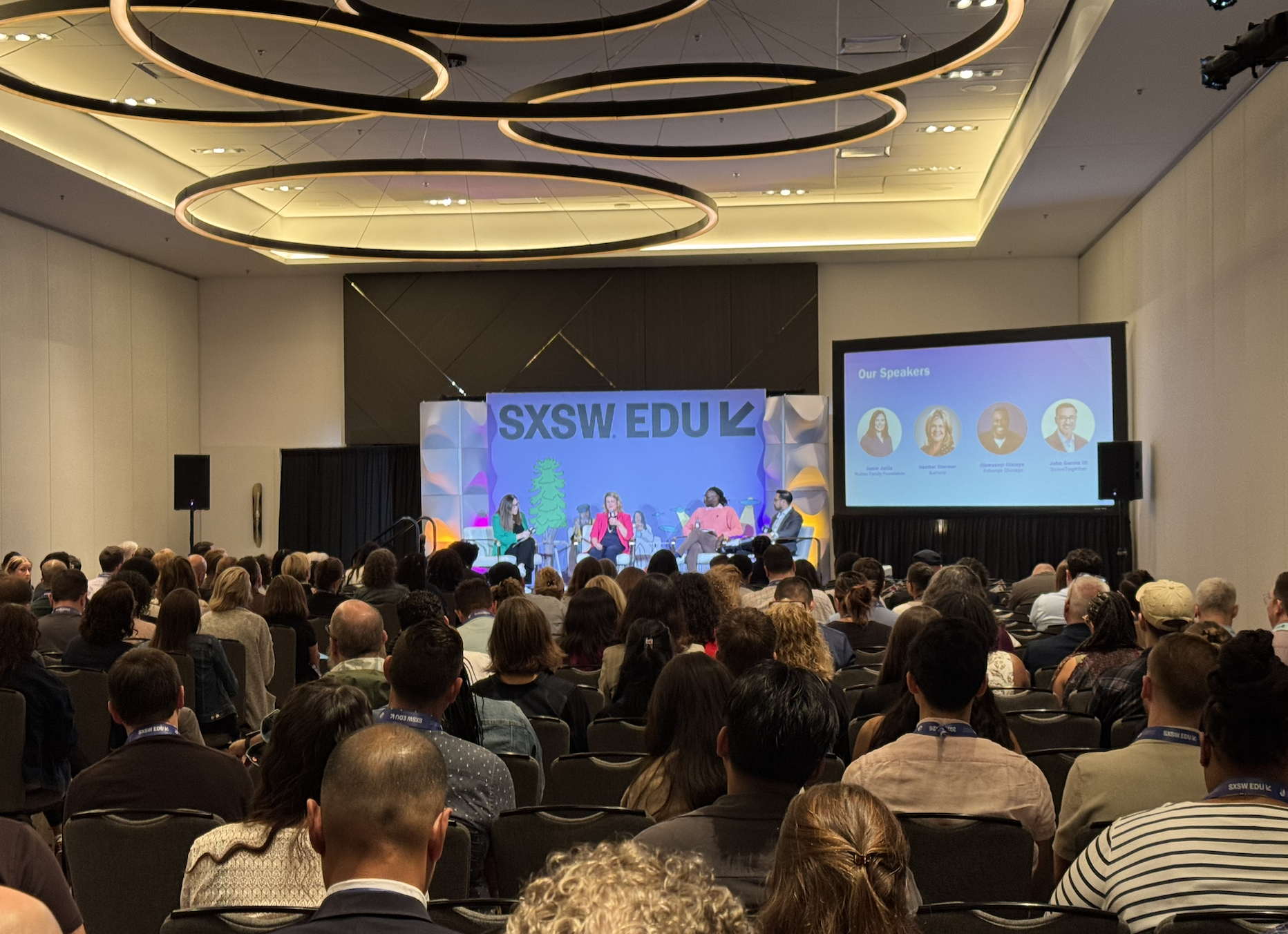
There's something that happens when you put educators, policymakers, founders, and funders in the same room for a few days. The conversations get a little more honest. The silos drop. And people who usually talk past each other start to listen more closely.
That's what I kept feeling at SXSW EDU this year, and I ended the conference with a lot to sit with.
In my role, I attend conferences to seek out signals and help course-correct: what's working, what's stalled, and where is the energy building? This year, with AI reshaping almost every conversation, those signals felt more blaring than ever.
Here are three takeaways that are still ringing in my ears, and why each one hits close to home for what we're working towards at Endless Foundation.

“The future belongs to kids who know how to create — with their hands, with code, with AI as their tool rather than their crutch.”
- Bridgette Lemoine
Endless Foundation
1. AI Should Create Friction, Not Remove It
One of the key signals came from a session on preparing kids for resilience in an AI-driven world, drawing on these findings from the Brookings Center For Universal Education. The key message was simple but profound: our brains are wired the way we use them.
If we hand over our thinking to AI entirely — the struggle, the drafting, the figuring-it-out — we don't just get lazier. We may actually lose our capacity for divergent, creative thought. The researchers call it cognitive offloading, and the risk isn't hypothetical. The findings reveal that when young adults write college admission essays without AI, their ideas range widely and unpredictably. With AI? The ideas converge. They narrow. The beautiful mess of an untrained imagination gets smoothed away.
This matters enormously to how I think about our work. At Endless, we often talk about empowering young people to be creators, not just consumers of technology (including AI). But this research sharpens that: the goal isn't just to put AI tools in kids' hands — it's to make sure those tools are sharpening their minds, not replacing them. Learning happens in the zone of proximal development, at the edge of capability, where things are just hard enough. The moment AI removes that productive struggle, we've lost the opportunity to build resiliency – to try, fail and try again.
The same research study found that “half of kids today say they are in passenger mode.” At Endless, our mission is to shift learners from passengers to explorers so that they have agency over their futures and can unlock their full potential.
2. Play Is Not a Nice-to-Have
There were two conversations about play happening at SXSW EDU this year — and while at face value they appeared to offer opposing viewpoints, there was a common thread uniting them – humans learn through active play.
The first session, “Screen Time vs. Green Time” noted that kids today are spending 5-9 hours a day on screens and fewer than 10 minutes outside. Meanwhile, anxiety diagnoses have doubled. Speakers from organizations like Outward Bound and Campfire made a compelling case that outdoor, unstructured time — the kind with real friction and real consequence — builds emotional regulation, resilience, and trust in ways that screen time struggles to replicate.
The second session about Minecraft EDU and game-based learning. The insight that landed hardest for me: when Minecraft's lesson designers made a math game too easy — too frictionless — students disengaged. It was the challenge, the failure, the moment of genuine not-knowing, that sparked real learning. When game making was handed over to the students, and they were challenged to build and create themselves, students showed back up in a real way.
I see these two sessions pointing to the same truth. Whether a kid is building a fort outside or hacking together a game mechanic, what matters is that they're actively participating in something and making choices that are genuinely theirs – ideally in collaboration with others. At Endless, we believe that game-making is one of the most powerful learning environments available precisely because it puts kids in the role of creator, not just player. They learn to code not because they were instructed to, but because they want their game to work. That kind of motivation is what we should be designing for everywhere — in classrooms, in schoolyards, and in communities.
Play is how you learn to resolve conflicts, persevere – and hopefully have some fun along the way.
3. Credentials Are Having a Moment — and It's About Time
Approximately forty million Americans have college credit but no degree. Let that sink in.
A whole session at SXSW EDU was dedicated to Learning Employment Records (LERs) and digital wallets — the idea that learners should be able to carry a verifiable, portable record of the skills they've actually built, rather than being judged solely on whether they completed a four-year degree. What struck me was how far this has moved from concept to reality. The University of the Cumberlands in Kentucky has credentialed over 700 people through a digital wallet system for teacher apprenticeships, complete with a visual progress meter that motivates learners as they go. And other states are following.
This is directly aligned with something we think about at Endless — how do we make the skills young people gain through game-making legible to employers, colleges, and the world? A learner who has designed and shipped a game has demonstrated project management, creative problem-solving, coding, iteration under constraints, and user empathy. Those are real, in-demand skills. But without a way to name and verify them, they're invisible on a resume or transcript. Digital credentials and skills wallets could change that — and we want to be part of building that future.
What I’m Leaving With
SXSW EDU reminded me why this work matters — and why it's hard. There are brilliant, committed people across the country working on these problems: funding models, credential systems, growing apprenticeship pipelines, designing engaging, play-based learning, and strengthening AI literacy. The challenge isn't a shortage of ideas. It's building the connections between them, and making sure the teachers and young people who need this most are at the center of the design.
That's what the Endless Foundation is here to do. We believe the future belongs to kids who know how to create — with their hands, with code, with AI as their tool rather than their crutch. If what you read here resonates, reach out, and let’s work together to build endless opportunities for the next generation.
To learn more about Endless Foundation visit, https://endlessglobal.com/the-endless-foundation.